
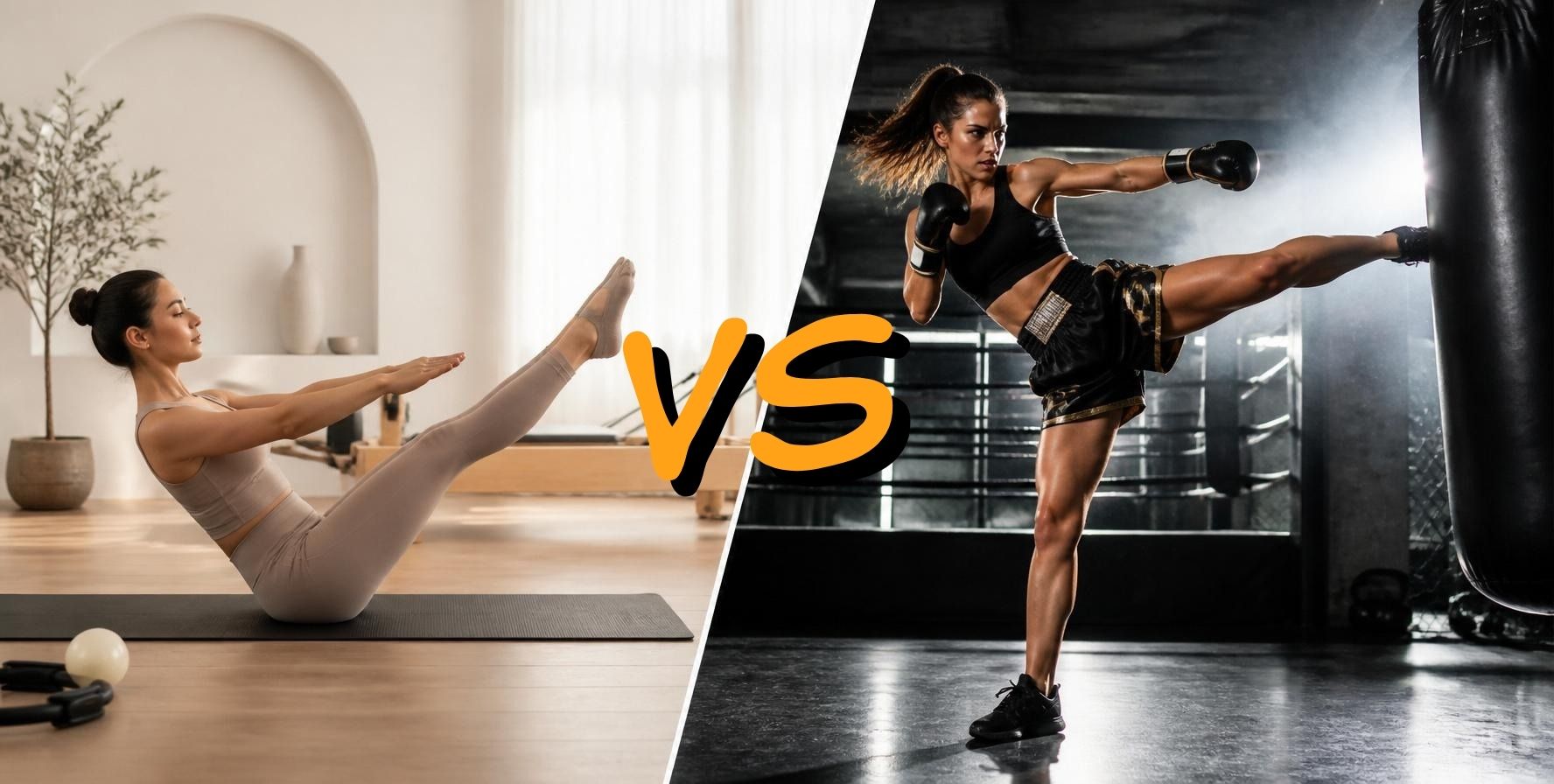
Pilates vs. Kickboxing: Which is Better?
You’ve got a free hour, a decent pair of leggings, and two very different studios pulling at your attention. One has reformers, soft lighting, and instructors who say “find your center” a lot. The other has heavy bags, pad work, and a coach yelling “six more!” while you question your life choices.
So in the Pilates vs Kickboxing battle, which one wins?
Honestly — it depends what you’re solving for. Let’s put both under a flashlight instead of a Instagram filter.
Round 1: Calorie Burn
This one isn’t close. A 154-lb person doing a moderate-intensity kickboxing class burns roughly 472 calories in 45 minutes, and heavier or more advanced sessions push that number higher — Harvard Health has put kickboxing’s calorie burn as high as 600 per hour depending on body weight and intensity.
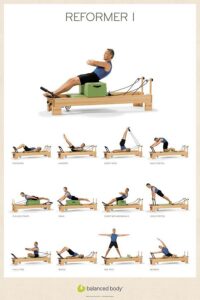
Pilates, by contrast, is built for control, not calorie torching. A 2020 study measuring oxygen consumption found Reformer Pilates burns around 155 calories per hour, with mat Pilates coming in lower at about 116 calories per hour. Even on the higher end, an advanced 50-minute Pilates class tops out around 254 calories — comparable to a brisk walk.
Pilates vs Kickboxing Verdict: If fat loss and cardio conditioning are the goal, kickboxing burns roughly 3-4x more calories per session.
Round 2: Strength and Muscle
Pilates isn’t just stretching in disguise. A 2016 study found that 12 weeks of consistent Pilates training produced measurable improvements in body fat percentage and muscle mass — particularly in the deep stabilizer muscles most people never train. If you sit at a desk all day and your core feels like an afterthought, Pilates rebuilds that foundation with precision.
Kickboxing builds a different kind of strength — the explosive, full-body kind. It ranks among the highest-calorie-burning combat sports because it recruits both upper and lower body muscle chains simultaneously, and the interval structure of round-based training does double duty on conditioning. Research on afterburn (EPOC) shows interval-style training in the 75-95% max heart rate range produces the largest post-workout calorie burn — a 45-minute class can keep burning calories for hours after you’ve left the building.
Pilates vs Kickboxing Verdict: Pilates builds stability and control. Kickboxing builds power, endurance, and total-body athleticism. Neither is “wrong” — they’re training different systems.
Round 3: Stress Relief and Mental Reset
Both formats score well here, just through different doors. Pilates leans on breathwork and controlled movement to bring your nervous system down a notch — it’s the workout equivalent of a deep exhale.
Kickboxing works the opposite direction: it gives you somewhere to put the tension. There’s something clarifying about hitting a bag with intent after a rough week — it’s not just cardio, it’s a release valve. Most people leave a kickboxing class more relaxed than when they walked in, not less.
Pilates vs Kickboxing Verdict: Tie. Pick based on whether you want to calm down or blow off steam — both work.
Round 4: Injury Risk and Accessibility
Pilates is low-impact and easy on the joints, which makes it a strong option if you’re rehabbing an injury or new to structured exercise. Kickboxing is higher-impact, but a well-run class scales intensity to the person — pad work and bag work are non-contact, so you get the athletic demand of the sport without the injury risk of actual sparring.
Pilates vs Kickboxing Verdict: Pilates has the edge for pure joint-friendliness. Kickboxing is more physically demanding but very manageable when it’s coached well.
So… Which Is Actually Better?
Neither one is “better” in a vacuum. If your goal is core stability, injury prevention, or a low-impact reset, Pilates does that job well. If your goal is burning calories fast, building functional strength, and getting a genuine stress release, the numbers — and most people’s actual experience — point toward kickboxing.
Plenty of people end up doing both — Pilates on a recovery day, kickboxing for intensity and cardio — and that combination isn’t a bad call. Each one covers a gap the other leaves open.
If you’re still on the fence, the easiest way to decide isn’t more research — it’s a single trial class of each. Most studios offer some version of a free or low-cost first session, and an hour on the mat or an hour on the bag will tell you more than any calorie chart can.