
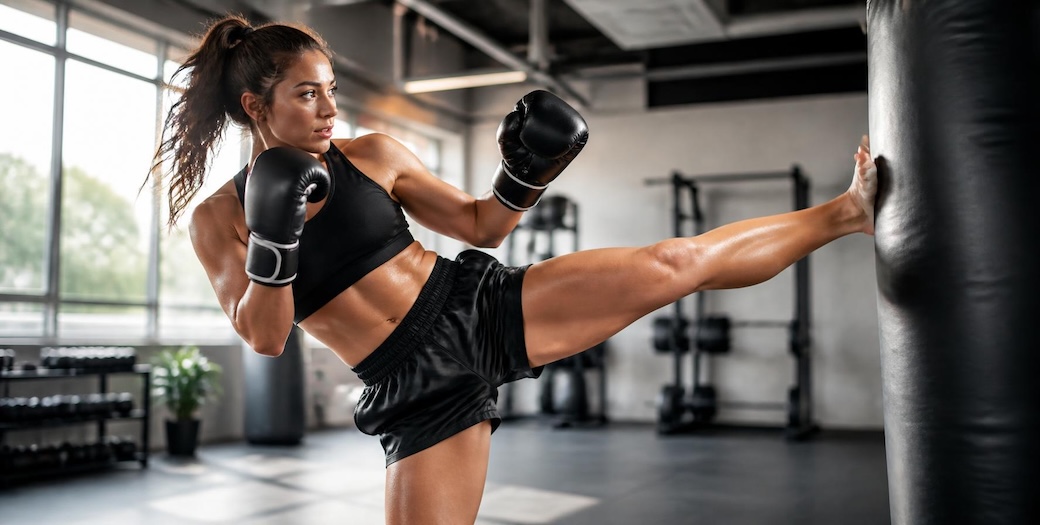
Does Kickboxing Help With Cellulite?
If you’ve ever caught a glimpse of dimpling on your thighs or glutes and wondered whether your workouts are doing anything about it, you’re not alone. Cellulite affects the vast majority of women at some point after puberty. Moreover, it’s one of the most searched — and most misunderstood — topics in fitness. So let’s break down what cellulite actually is, why it happens, and whether kickboxing can realistically move the needle.
What Is Cellulite, and Why Does It Happen?
Cellulite isn’t just “extra fat.” It’s a structural issue in the skin. Underneath the surface, women have fibrous bands called septae that connect skin to muscle. There are pockets of fat sitting between them. When those fat cells expand, they push up against the skin, while the fibrous bands pull down — and that push-pull is what creates the dimpled, uneven texture most people recognize as cellulite.
Research published in Dermatologic Surgery points out that cellulite shows up even in young, lean women with no excess body fat. This is a big clue that this isn’t purely a “weight problem.” The review found that clinical approaches targeting those fibrous septae — rather than just burning fat — tend to produce the most durable improvements in skin texture.
A few other factors can stack the deck against women specifically:
- Hormones. Estrogen plays a direct role in fat storage and skin elasticity, which is part of why cellulite is so much more common in women than men.
- Skin architecture. In women, the connective tissue under the skin runs in a vertical pattern, making it easier for fat to poke through. In men, it’s more of a criss-cross weave, which is one reason cellulite is far less common in guys.
- Genetics and connective tissue quality. Some people simply inherit weaker or thinner connective tissue, making the dimpling more visible regardless of body fat percentage.
The bottom line from the dermatology research: cellulite is multifactorial, it’s largely structural, and no single fix — cream, massage, or otherwise — has been shown to eliminate it entirely.
So Can Exercise Actually Change Cellulite?
This is where you may get discouraged, because it’s true that no workout will dissolve the fibrous bands causing the dimpling. But that doesn’t mean training has no effect. Exercise works on the two variables that actually are in your control: the fat sitting between those bands, and the muscle tone underneath them.
How Kickboxing Specifically Helps
Kickboxing checks a few important boxes when it comes to improving how skin looks and feels. Even if it’s not “curing” cellulite in the clinical sense, it can help.
It’s genuinely effective interval training. Kickboxing is built around short, intense combinations followed by brief recovery — the same structure researchers use to define high-intensity interval training (HIIT). A pilot study on boxing-style HIIT in adults with abdominal obesity, published in the National Library of Medicine, found it to be both feasible and effective for improving body composition compared to an equivalent dose of brisk walking. That combination of intensity and full-body engagement is exactly what drives fat loss over time. In turn, less fat between the septae means less pronounced dimpling.
It builds muscle under the skin. Every round of pad work, every switch step, every rear roundhouse is loading your glutes, quads, hamstrings, and core. Dermatologists have specifically pointed to increasing muscle mass in affected areas as one of the few exercise-based strategies that can visibly improve the appearance of cellulite. This is because firmer muscle underneath gives the skin a smoother, more taut surface to sit on.
It improves circulation. Kickboxing gets your heart rate up and keeps it there. This supports blood flow and lymphatic drainage — both of which are tied to skin quality and fluid retention, a contributing factor in how pronounced cellulite appears.
It’s sustainable. The treatments with the least evidence behind them tend to be one-time fixes — creams, wraps, single massage sessions. However, the research consistently favors consistency: repeated training over weeks and months, not a single class or a quick fix.
The Realistic Take on Cellulite
Kickboxing won’t erase cellulite — nothing will, according to the current research. What it will do is help you lose fat, build lean muscle, and improve circulation. All of these can make cellulite less noticeable over time. If you’re someone who wants a workout that’s actually fun to stick with while it does that work in the background, that’s exactly the lane kickboxing lives in.